这是一个轻量级异步日志器(async logger)。目标是用现代 C++(线程、互斥、条件变量)实现一个线程安全、低阻塞的日志写入方案:生产者将格式化后的日志消息推入队列,后台消费者线程异步写入文件并可选地输出到终端。整体实现包含一个简单的占位符格式化(暂用{},可自行修改)、类型到字符串的通用转换和优雅的后台线程关闭机制。
hpp
#ifndef MY_LOG
#define MY_LOG

#include <iostream>
#include <queue>
#include <mutex>
#include <string>
#include <condition_variable>
#include <thread>
#include <fstream>
#include <atomic>
#include <sstream>
#include <vector>
#include <stdexcept>

/**
 * @brief 将单个参数转换为字符串的辅助函数。
 *
 * 使用 std::ostringstream 将任意支持 operator<< 的类型转换为 std::string。
 *
 * @tparam T 参数类型(可以是右值引用或左值引用类型)。
 * @param arg 要转换的参数,必须可通过 operator<< 输出到流。
 * @return std::string 参数的字符串表示。
 */
template <typename T>
std::string my_to_string(T &&arg)
{
  std::ostringstream oss;
  // 如果T为自定义类型,需要实现<<的重载
  oss << std::forward<T>(arg);
  return oss.str();
}

/**
 * @brief 线程安全的日志消息队列。
 *
 * 该类提供生产者-消费者模式的简易实现:多个生产者可以调用 push()
 * 将日志消息放入队列,单个或多个消费者通过 pop() 获取消息。通过 shutdown()
 * 可以通知所有等待的线程退出,用于优雅关闭后台线程。
 */
class LogQueue
{
private:
  std::queue<std::string> _queue;
  std::condition_variable _cv;
  std::mutex _mtx;
  bool _isshut = false;

public:
  /**
   * @brief 将一条日志消息加入队列。
   *
   * 线程安全,内部会在队列从空变为非空时通知一个等待线程。
   *
   * @param msg 要加入的日志消息(按值或按引用传入会被拷贝到队列中)。
   */
  void push(const std::string &msg)
  {
    std::lock_guard<std::mutex> lock(_mtx);
    _queue.push(msg);
    if (_queue.size() == 1)
    {
      _cv.notify_one();
    }
  }

  /**
   * @brief 从队列中弹出一条消息(阻塞直到有消息或队列被关闭)。
   *
   * @param msg 输出参数:成功弹出时存放消息。
   * @return true 成功弹出并返回消息。
   * @return false 队列已关闭且为空,用于通知消费者退出循环。
   */
  bool pop(std::string &msg)
  {
    std::unique_lock<std::mutex> lock(_mtx);
    // 防止虚假唤醒,需要判断队列是否为空再继续
    // 线程挂起会解锁
    _cv.wait(lock, [this]() -> bool
             { return !_queue.empty() || _isshut; });
    // 消费逻辑
    if (_queue.empty() && _isshut)
      return false;

    msg = _queue.front();
    _queue.pop();
    return true;
  }

  /**
   * @brief 关闭队列并通知所有阻塞的等待者。
   *
   * 该操作会将内部状态标记为关闭,并唤醒所有在 pop() 上等待的线程。
   */
  void shutdown()
  {
    std::lock_guard<std::mutex> lock(_mtx);
    _isshut = true;
    _cv.notify_all();
  }

public:
  /**
   * @brief 构造函数,初始化队列。
   */
  LogQueue() = default;
  /**
   * @brief 析构函数。
   */
  ~LogQueue() = default;
};

/**
 * @brief 异步日志器类。
 *
 * Logger 在构造时打开指定的日志文件并启动一个后台线程,从内部的 LogQueue 中
 * 异步消费日志消息并写入文件;可选地同时输出到控制台。析构时会优雅关闭后台线程并关闭文件。
 */
class Logger
{
public:
  /**
   * @brief 构造并启动 Logger。
   *
   * 打开日志文件并启动一个后台线程用于异步写入。
   *
   * @param filename 日志文件路径(如果文件不存在会创建)。
   * @param coutopen 如果为 true,则在写入文件的同时将日志输出到 std::cout(线程安全)。
   * @throws std::runtime_error 无法打开日志文件时抛出异常。
   */
  Logger(const std::string &filename, bool coutopen) : _logfile(filename, std::ios::out | std::ios::app), _exitflag(false), _console(coutopen)
  {
    if (!_logfile.is_open())
    {
      throw std::runtime_error("failed to open log file.");
    }
    _workerthread = std::thread([this]()
                                {
          std::string msg;
          while (this->_logqueue.pop(msg)){
            if (this->_logfile.is_open()){
              _logfile << msg << std::endl;
            }
            if (_console){
                std::lock_guard<std::mutex> lock(_cout_mtx);
                std::cout << msg << std::endl;
            }
          } });
  }

  /**
   * @brief 构造函数(不输出到控制台)。
   *
   * 等同于 Logger(filename, false)。
   *
   * @param filename 日志文件路径。
   * @throws std::runtime_error 无法打开日志文件时抛出异常。
   */
  Logger(const std::string &filename) : _logfile(filename, std::ios::out | std::ios::app), _exitflag(false), _console(false)
  {
    if (!_logfile.is_open())
    {
      throw std::runtime_error("failed to open log file.");
    }
    _workerthread = std::thread([this]()
                                {
          std::string msg;
          while (this->_logqueue.pop(msg)){
            if (this->_logfile.is_open()){
              _logfile << msg << std::endl;
            }
            if (_console){
                std::lock_guard<std::mutex> lock(_cout_mtx);
                std::cout << msg << std::endl;
            }
          } });
  }

  /**
   * @brief 析构函数,停止后台线程并关闭文件。
   *
   * 将标志设置为退出状态、调用 LogQueue::shutdown() 通知后台线程,并 join 线程。
   */
  ~Logger()
  {
    _exitflag = true;
    _logqueue.shutdown();
    if (_workerthread.joinable())
    {
      _workerthread.join();
    }
    if (_logfile.is_open())
    {
      _logfile.close();
    }
  };

public:
  /**
   * @brief 将格式化消息异步写入日志。
   *
   * 使用 formatMessage() 将 format 中的 {} 占位符替换为后续参数的字符串表示,
   * 然后将生成的消息推入队列,由后台线程异步写入文件(以及可选的控制台)。
   *
   * @tparam Args 参数类型列表。
   * @param format 带有 {} 占位符的格式字符串。
   * @param args 与占位符对应的参数列表。
   */
  template <typename... Args>
  void log(const std::string &format, Args &&...args)
  {
    _logqueue.push(formatMessage(format, std::forward<Args>(args)...));
  }

private:
  /**
   * @brief 将格式字符串中的 {} 依次替换为传入参数的字符串表示。
   *
   * 简单实现,不支持索引、宽度或其他格式化选项;当参数少于占位符时保留 "{}" 原样,
   * 当参数多于占位符时多余参数被忽略。
   *
   * @tparam Args 参数类型列表。
   * @param format 包含 {} 占位符的格式字符串。
   * @param args 参数列表。
   * @return std::string 替换后的最终字符串。
   */
  template <typename... Args>
  std::string formatMessage(const std::string &format, Args &&...args)
  {
    std::vector<std::string> arg_string = {my_to_string(std::forward<Args>(args))...};
    std::ostringstream oss;
    size_t arg_index = 0;
    // 遍历格式字符串,替换{}为参数字符串
    for (size_t i = 0; i < format.size(); ++i)
    {
      if (format[i] == '{' && i + 1 < format.size() && format[i + 1] == '}')
      {
        // 如果还有参数,替换为参数字符串,否则保留原样
        if (arg_index < arg_string.size())
        {
          oss << arg_string[arg_index];
          ++arg_index;
        }
        else
        {
          oss << "{}";
        }
        ++i; // 跳过下一个字符
      }
      else
      {
        oss << format[i];
      }
    }
    return oss.str();
  }

private:
  LogQueue _logqueue;
  std::thread _workerthread;
  std::ofstream _logfile;
  std::atomic<bool> _exitflag;
  std::mutex _cout_mtx; // 保护 std::cout 的互斥锁
  bool _console = false; // 是否同时输出到控制台
};

#endif
使用方法
这是一个head-only的库,只需要简单地包含头文件即可以调用,下面是使用示例
main.cpp
#include "log.hpp"
#include <chrono>
#include <thread>

int main() {
	try {
		Logger logger("example.log", true);
		logger.log("hello {}, {}", "world", 2026);
		logger.log("another line: {} - {}", "test", 3.14);
		logger.log("this is a log message without parameters");
		logger.log("logging with more parameters: {}, {}, {}", "param1", 42, 3.14);
		logger.log("logging with fewer parameters: {}, {}", "only one");
	} catch (const std::exception &e) {
		std::cerr << "logger init failed: " << e.what() << std::endl;
		return 1;
	}
	return 0;
}
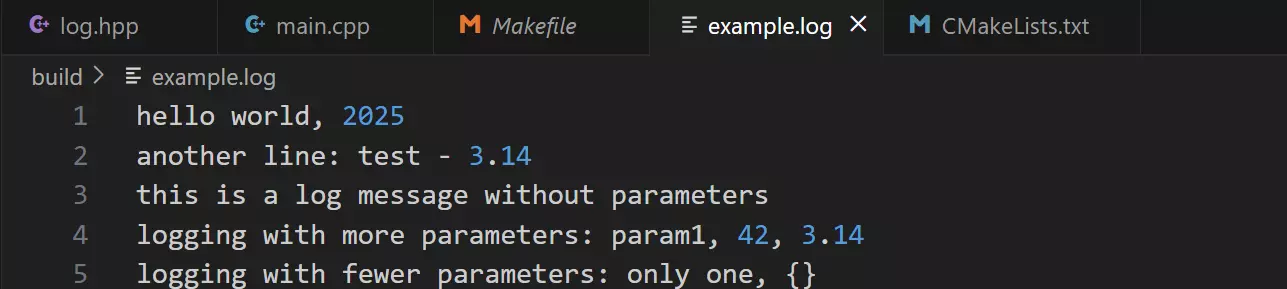
使用效果(同时开启终端输出与文件输出时)
文件输出:
终端输出:

后续可以考虑增加不同输出等级限制,比如【Info】 【Warn】 【Error】这些